
By Sara Hinds
When a celebrity passes away, it’s normal to feel a complicated swirl of sadness and shame. How can you mourn somebody you never met? And should you? But for a beloved figure like Jane Goodall, her legacy and impact transcends those questions. Her research, work and activism with chimpanzees in Tanzania and overall wildlife conservation spanned six decades and impacted multiple generations.
For many in the Doane community, Jane’s passing on October 1, 2025, brought forth memories of meeting the conservationist and for two female alumni, following in her footsteps since they met her on Doane's campus in 2007.
Amy Sherwood ’07 and Liz Doane ’10 both idolize Goodall. As young girls interested in science, looking up to Jane was natural. Both Amy and Liz developed a foundational love of the outdoors as kids, family camping trips in the summer for Amy, playing outside and making “seasonal soup du jour” from mud and water for Liz.
Coming to Doane and majoring in biology was another decision that just made sense for them.
They even crossed paths as members of Doane’s Roots and Shoots chapter. First-year student Liz had a tenacious streak and was determined to make a change in the world. As a senior, Amy had learned about challenges in the natural world like climate change and destruction and was motivated to enter the conservation field after graduation. Roots and Shoots served as an outlet for their passions as young, budding activists and conservationists.
In 2005, Professor of Biology Brad Elder started the school’s chapter of the global nonprofit organization that Jane founded in 1991 to empower youth to make a difference on environmental, conservation and humanitarian issues in their communities.
Roots and Shoots at Doane hosted plant sales on Earth Day, repurposed trash bags into handbags and created mosquito netting to hand out during study abroad research trips to Africa.
One project Liz remembers is from her first year at Doane in 2006. Liz was running for student class president on a platform of recycling. Back then, you could only toss your plastic water bottle or old essays in the trash — no recycling existed on the Crete campus. Roots and Shoots reached out to Liz to combine their efforts.
“Over the period of the four years that I was at Doane, we went from talking about it, to figuring out how to do it, to being able to rent the janitorial van,” Liz said.
She even collected the recycling around campus, and drove the van to drop it off at the community recycling center.
“By the time I graduated it was institutionalized, single-stream recycling.”
It was also during Liz’s first year at Doane when Jane visited campus. The university was awarding Jane with an honorary degree — the highest distinction Doane can grant to an individual.
Doane’s student newspaper, The Owl, reported approximately 1,700 people attended the afternoon ceremony where Jane received her degree. She addressed the crowd in Fuhrer Fieldhouse and spoke about her work with chimpanzees and the responsibility humans have to care for our world.
Goodall said it was a great honor to receive a degree from Doane.
“If I was a chimpanzee, I would be an excited chimpanzee,” Goodall began her speech, a stuffed monkey sitting appropriately by her side. “And if I was an excited chimpanzee, I would sound like this…”
She imitated a chimp, spreading smiles and laughter through the gym.
[Excerpt from The Owl published Thursday, March 15, 2007, article written by JoAnna Reiter Bausch ’09]
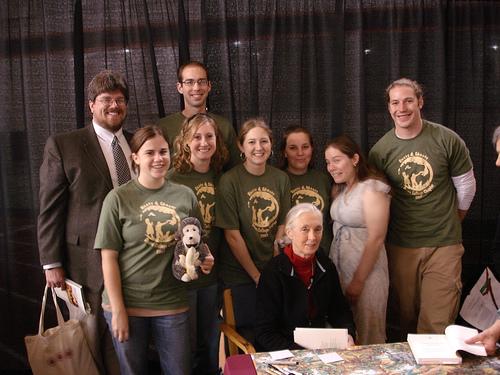
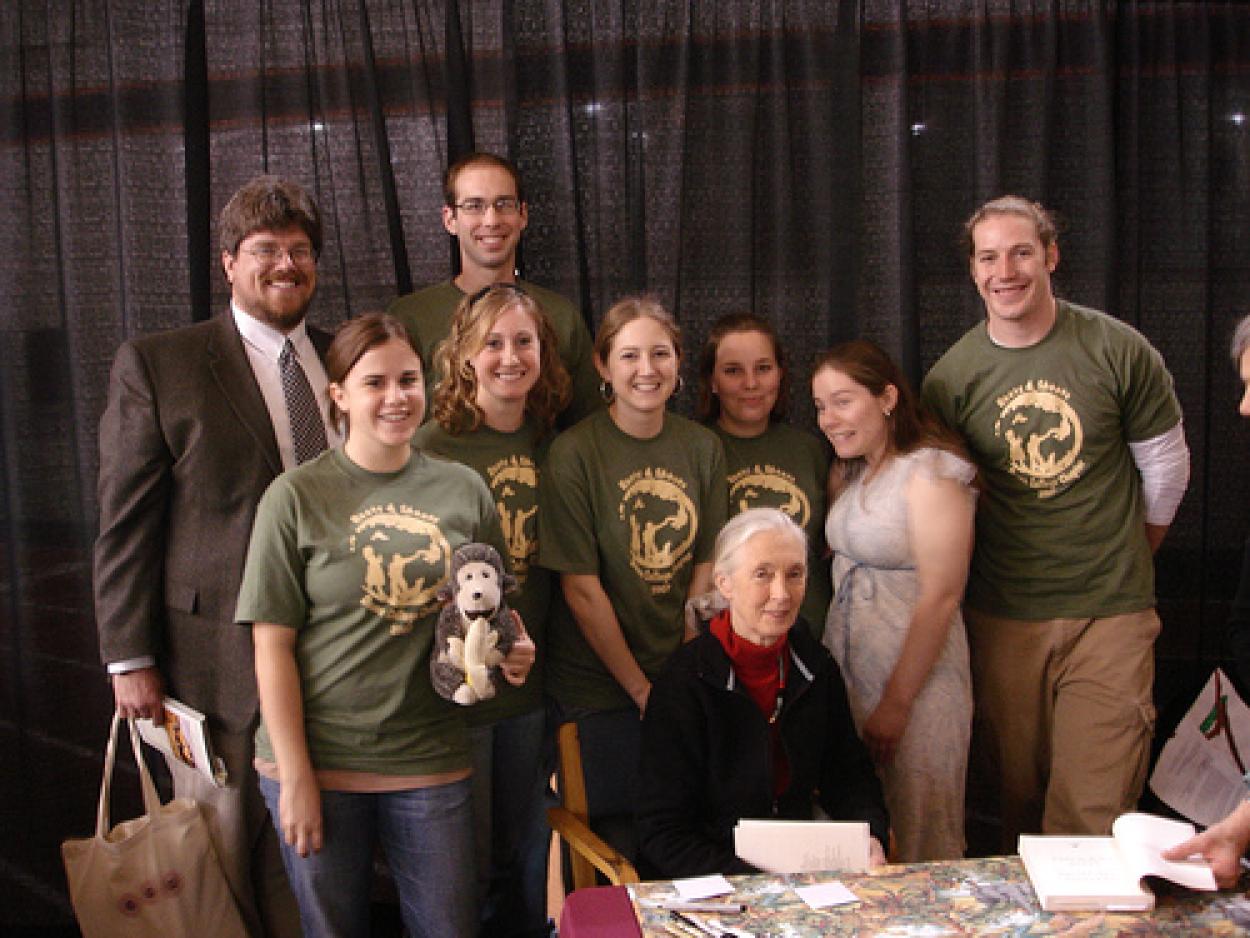
Earlier in the day, Roots and Shoots members from Doane and across Nebraska attended a press conference to hear Jane speak in a more intimate setting. Liz literally rubbed shoulders with Jane, a moment captured forever in a photograph.
Which is a good thing, because Liz doesn’t remember much from that meet-and-greet aside from crying upon coming face-to-face with Jane.
“It’s hard for me to remember details, because I just remember being so awestruck in the fact that I’m in the same room as Jane Goodall,” Liz said.
She feels just as emotional reflecting on her career up to now, and how Jane helped pave the way for women like her and Amy.
“She really laid down the groundwork for that pathway to get into careers like that,” Liz said. “Not just women in science, but anybody interested in species work, anybody interested in conservation, anybody that just has this heartache or desire to do something.”
Shortly after meeting with Jane in 2007 Liz landed a coveted spot in an exchange program through the Jane Goodall Institute’s Roots and Shoots program. She was one of five college students across the United States chosen for the opportunity.
During the 10-day trip to China, Liz and her peers met with individuals and local Roots and Shoots groups doing important outreach and education work. One man who was known as “Tony the Tiger” educated people about snare hunting and how it hurt the Bengal Tiger population. Local Roots and Shoots groups were painting a mural in the children’s hallway of a leukemia ward and adding enrichment for animals in zoo exhibits.
Today, Liz works as the first education specialist for the San Juan Preservation Trust, the oldest land trust in the state of Washington.
She shares with visitors the importance of species special to the island like the Western Bluebird and the Island Marble Butterfly. She strives to create what she calls “whoa moments.” Because when someone witnesses or learns something so profound that they say “whoa,” they’ll likely remember and tell others about it.
“I'm not always going to see it play out, but I can hope that that's going to happen,” Liz said. “And that was Jane to a ‘T’ [she] was the embodiment of hope.”
Amy also followed in Jane’s footsteps. After graduate school she took a job as an international volunteer and project coordinator in Dar es Salaam, Tanzania, the largest city in the country and location of Jane’s home.
She worked with local Roots and Shoots chapters on beach and neighborhood cleanups and environmental education in the schools. She managed the volunteers — and Jane’s house.
The volunteers, like Amy, lived in her house. Part of Amy’s gig included coordinating the people doing repairs and upkeep on Jane’s house. Jane even stopped by a few times during the year Amy lived in her house. Jane would hang out on the back porch and her son, Hugo, who lived next door, would swing by.
“I was intimidated because I was young and had idolized her, but she was very down-to-earth [and] easy to talk to,” Amy said.
Amy noticed how mission-driven Jane was. She would’ve been in her 70s when Amy was around her, and Jane frequently traveled and spoke at events.
“It was striking how much her passion for the work she was doing and the mission she was tied to really did seem to drive her,” Amy said.
Amy spent almost seven more years in Africa, managing agriculture programs in Kenya and Ethiopia with Nuru International. She currently does strategy and impact measurement with Climate Works Foundation, a nonprofit based in San Francisco.
It’s a more behind-the-scenes job compared to her hands-on and grassroots efforts in Africa, but just as critical.
“There's not going to be like one solution that fixes everything,” Amy said of climate change. “It just takes a lot of little contributions from a bunch of different people. And so I feel motivated to have a career that can be part of that wave of people that are trying to figure it out.”
Amy’s words on climate change can be applied to the wider conservation efforts Jane stood for. Change requires all kinds of efforts — educators, frontline workers, strategists — from all ages.
Liz and Amy heard similar words from Jane herself, back on that March day on the Doane campus, that happiness in life is achieved by “going out and doing something with others to make the world a better place.”


