
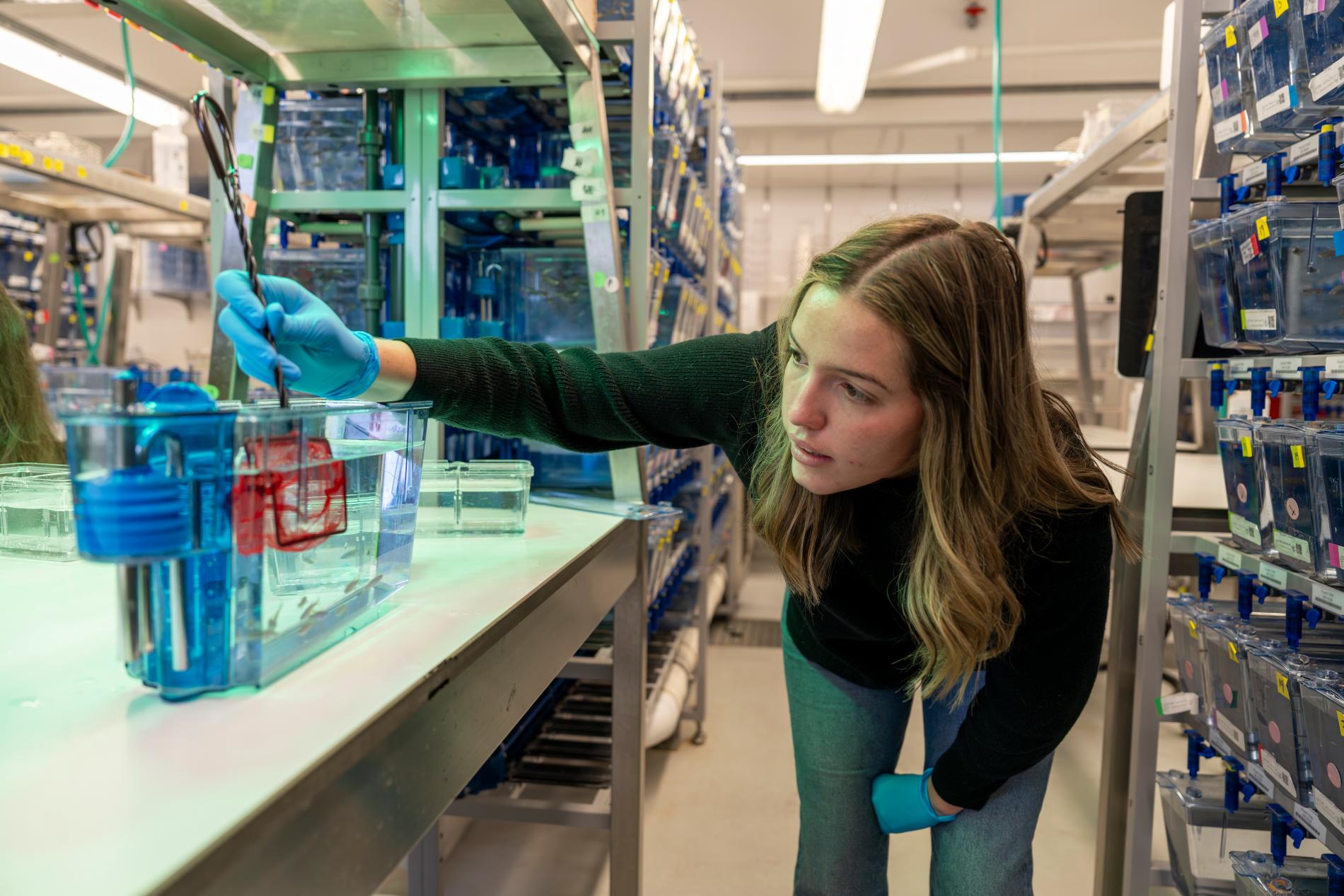
Rachel Bedford '17, Ph.D. and Her Path from Science Research to Communication
By Kelly Stenka
When Rachel Bedford '17, Ph.D. stepped foot on Doane University’s campus, she was set out to complete her English major. At least, that’s how the rough draft of Bedford’s story began. But as any good storyteller knows, the best tales are full of unexpected twists and new characters who change the plot entirely.
“In your first year, you’re required to take a variety of courses,” Bedford recalls. “I signed up for Intro to Biology just to check off a requirement.” What she didn’t expect was to fall in love with it.
The course, taught by Tessa Durham Brooks, Ph.D., wasn’t just lectures and quizzes. Instead, students collected soil samples around Crete in search of bacteriophages — viruses that infect bacteria — cultivating them in the lab and watching as their discoveries came to life under high-resolution imaging. “We even got to name the phages and put them into a national database,” she says, laughing. “It was the first time I felt like I was doing science.”
Brooks noticed Bedford’s enthusiasm and reached out. “She encouraged me to take another class. That mentorship was a turning point.” By the end of her first year, Bedford changed her major to biology.
It wasn’t long before a summer opportunity with the INBRE program, a national biomedical research network funded by the NIH, took her to Creighton University. “I was able to work with Professor Laura Bruce, where I was first introduced to neuroscience and began using zebrafish as a model to explore the brain,” Bedford recalls.
That summer changed everything.
“It was the first time I realized that science could be a full-time career,” Bedford says. “That you could actually spend your life asking questions and trying to answer them.”
Back at Doane, she joined a chemistry lab under the mentorship of Andrea Holmes, Ph.D., to keep building her skills. She picked up a second major in psychology to better prepare herself for graduate work in neuroscience. And when it came time to apply, she set her sights on one place: the University of Oregon — the birthplace of zebrafish research.
“It felt so full circle,” she says. “To start this journey in Nebraska, and then end up where zebrafish were first used as a model organism, getting to work alongside the scientists who pioneered the field. It was surreal.”
Bedford’s research focused on a mystery that had puzzled scientists for nearly a century: Why do certain “communication channels” between cells, called gap junctions, only show up during early muscle development, then disappear?
Gap junctions are tiny tunnels that let cells communicate instantly, like texting instead of mailing a letter. While they are widespread and vital during development, they mysteriously disappear from adult skeletal muscles, leaving scientists puzzled as to why.
Using zebrafish as a model — due to their genetic, muscle, and nerve development similarities to humans 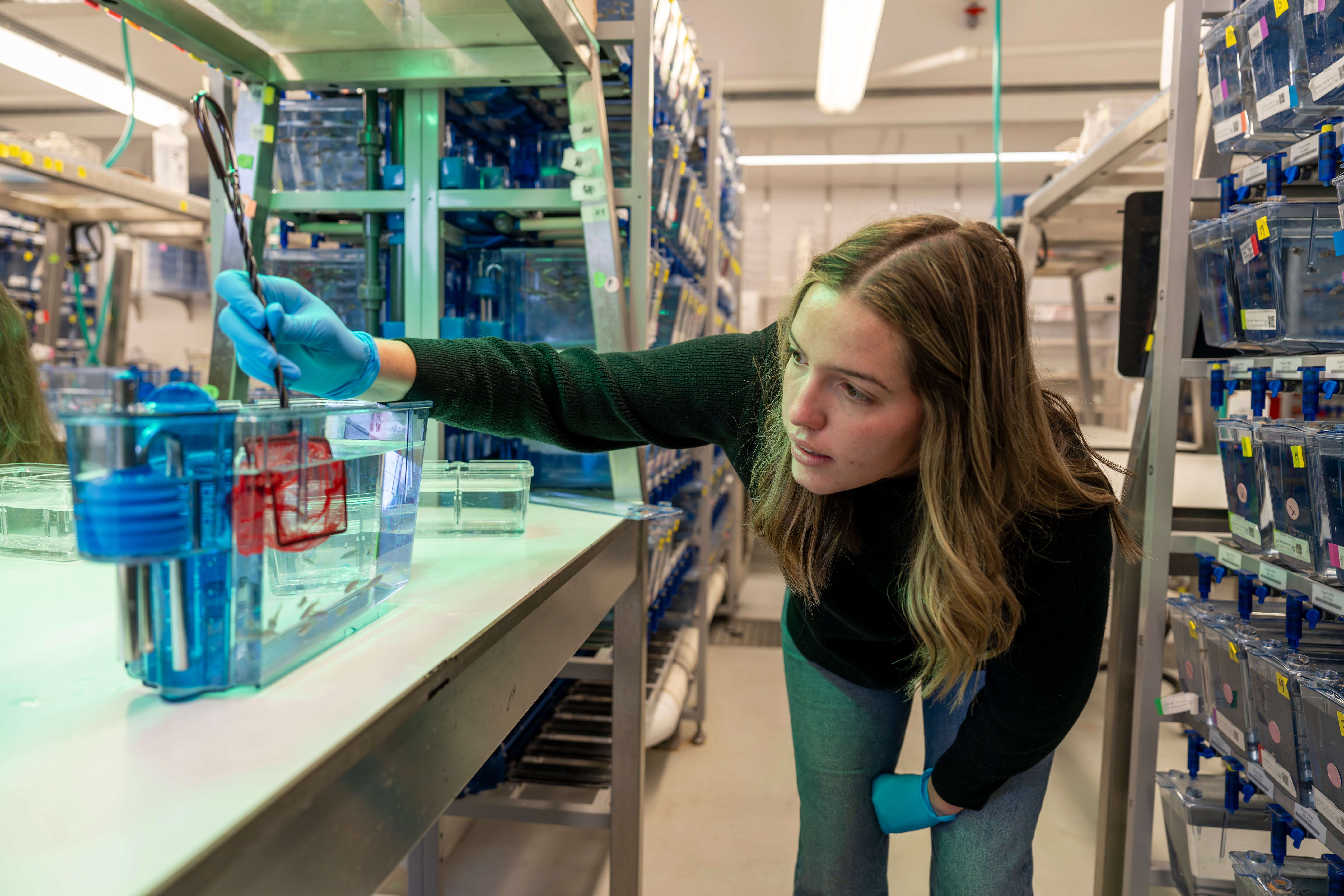 — Bedford discovered that one specific gap junction channel plays a key role in this short window of development. This gap junction channel helps deliver electrical signals from the brain and spinal cord to the developing muscles, telling them how to grow and form properly.
When that gap junction channel was removed, the zebrafish developed weak, wavy muscles and had trouble swimming. That showed just how important those early signals are for building strong, functional muscles.
Even more exciting? The same code to create these gap junction channels exists in humans and other mammals. Scientists believe it could be linked to rare neuromuscular disorders in children — a connection that hadn’t been made before.
Bedford’s research could one day help doctors identify these conditions earlier and, eventually, develop treatments.
After completing her Ph.D. in 2023, Bedford began a postdoctoral fellowship focused on unraveling the mysteries of motor neuron death — an area critical to understanding diseases like ALS. “It was meaningful work,” she says, “but I realized that being the person pipetting at the bench every day wasn’t where I felt most alive.”
What truly energized her was a passion she had nurtured since her early days at Doane: communicating science beyond the lab. This spark first ignited in a comparative anatomy class which led to competing in a Science Slam at the University of Nebraska–Lincoln, where she turned complex research into an engaging presentation for a general audience. This experience, combined with ongoing faculty mentorship, helped solidify her unique dual identity as both scientist and storyteller.
Now, she’s fully stepped into that role.
Today, Bedford works at the Phil and Penny Knight Campus for Accelerating Scientific Impact at the University of Oregon. Her title — Research Associate for Scientific Communication. “My job is to create scientific content that’s engaging and meaningful for our stakeholders here. To show the impact of the work happening here.”
Bedford’s job is to capture and communicate that momentum — to tell the stories behind the breakthroughs, the people behind the papers, and the promise of what’s to come. It’s a career that merges her love of language with her scientific training, and a full-circle moment for a former English major.
“Ultimately, I see myself as a liaison — someone who can speak the language of science and translate it for different audiences,” she says.
The shift from benchwork to creative storytelling has been energizing. “I think one of the things I’m really trying to do is to embrace the complexity of things and not be dismissive,” she explains. Rather than oversimplifying, Bedford focuses on making science understandable while respecting its nuances. Her goal is to help people connect with the “why” behind the research, showing not just results, but the obstacles and breakthroughs that make science worth following.
Bedford credits Doane as the place where her journey into science truly began. Her story is a testament to what happens when institutions like Doane create room for exploration, when mentors pay attention, and when students are willing to follow curiosity wherever it leads.
“I genuinely don’t think I would have become a scientist if I had gone somewhere else,” she says. “I think I would have gotten lost in the cracks at a bigger school. Doane made all the difference.”
And it all started because one professor noticed a student having fun in a lab.


